
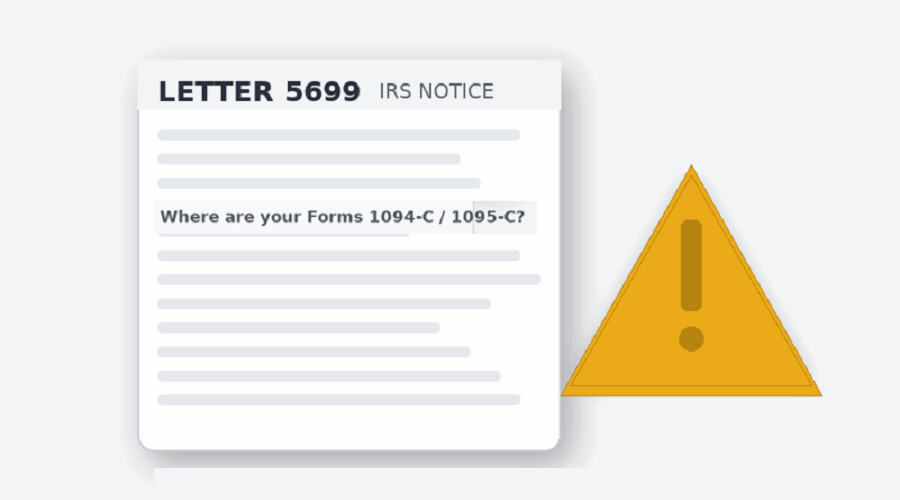
Few things rattle an employer like an envelope from the IRS asking where your ACA forms are. The good news: a missed or late 1094-C/1095-C filing is fixable, and moving quickly keeps a paperwork problem from turning into a penalty. Here’s the playbook.
First 24–48 hours: stabilize the situation
- Call the number on the notice. Ask for a 30-day extension to respond or file. Most agents will grant it when you call promptly.
- Document the call. Write down the agent’s name and badge number , the date/time, and what was granted.
- Start gathering data (payroll hours, FT status, offers of coverage, plan affordability, controlled-group info) so you can complete 1094-C/1095-C for the year in question.
Tip: You usually don’t need an attorney yet just for a “where are your forms?” notice, but if you miss deadlines and the IRS issues a penalty assessment, counsel can be very helpful.
Which IRS letter did you get?
- Letter 5699, “Where are your Forms 1094/1095-C?” This is the inquiry the IRS sends when it believes you should have filed but didn’t. Respond and file quickly to keep it from escalating.
- Letter 5698, Follow-up / potential non-compliance Commonly issued if 5699 isn’t resolved on time; can lead to failure-to-file/furnish penalties.
- Letter 226J, Proposed Employer Shared Responsibility Payment (ESRP) This is different: it’s a proposed 4980H penalty based on your filed codes and employees’ premium tax credits. It has its own 30-day response process.
- Notice 972CG, Proposed information-return penalties Used for late/incorrect information returns; amounts are indexed annually.
File what’s missing, don’t wait for another letter
- Confirm ALE status year-by-year. If you averaged 50+ FTEs/FTE equivalents in the prior year, you’re an ALE for the filing year.
- File the current year in the notice (for many employers this is now 2024 or 2025 ) and identify any earlier gaps. An IRS inquiry about one year doesn’t prevent them from looking at other years .
- How far back? Many employers clean up at least the last three years ; some go back farther (up to seven) depending on risk tolerance and records. Remember, when returns weren’t filed , the statute of limitations may not start, so getting everything on file reduces exposure. (Penalty amounts vary by year; see IRS guidance.)
“Furnish on request” now applies to 1095s, filing with the IRS still required
Beginning with 2024 forms (furnished in 2025) , the Paperwork Burden Reduction Act lets ALEs furnish Forms 1095-C to individuals only upon request , if you post the required website notice and honor requests by the later of Jan 31 or 30 days after the request . This does not change your duty to file with the IRS (generally by March 31 electronically). Also check state mandates (e.g., CA, MA, NJ, RI, DC).
A practical game plan (agents can share this)
- Week 1: Call the IRS, secure the extension, document the call. Engage a third-party administrator (TPA) experienced in ACA reporting to build your data set and generate 1094-C/1095-C.
- Week 2–3: Reconcile full-time determinations (monthly vs. look-back), verify affordability safe harbor, confirm controlled-group aggregation, QA employee data/TINs.
- Week 4: E-file with the IRS and prepare your website notice (if using furnish-on-request). Set a process to respond to any employee requests within 30 days .
When to involve counsel
- You’ve received Letter 226J proposing an ESRP, or a 972CG penalty you plan to challenge.
- There are complicated controlled-group/common ownership issues, or prior filings appear materially incorrect .
Bottom line
Call, extend, file. A quick phone call can buy you 30 days to get compliant; use it. Get the missing 1094-C/1095-C filed (and fix any earlier gaps), post the furnish-on-request notice for 1095s, and partner with a capable TPA to keep things on schedule. Waiting turns a simple cleanup into a formal penalty process.
Educational summary only; not legal or tax advice.