
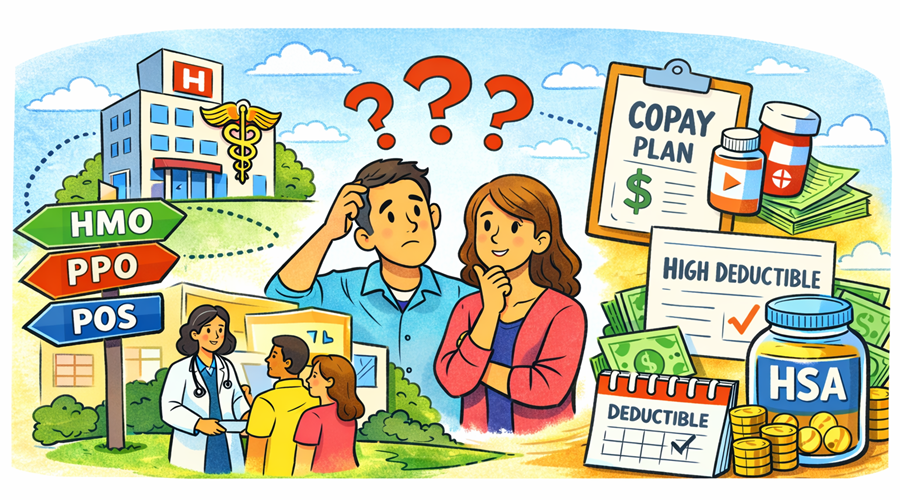
This week: HMO, PPO, or HSA? Employees mix these up constantly, and the confusion leads to bad plan choices and buyer’s remorse. This week we clear it up in plain language you can hand straight to clients and their teams.
If you’ve been in this business for any length of time, you’ve probably heard a client say something like, “We don’t have a PPO. We have an HSA plan.” It sounds reasonable, but it reveals a fundamental misunderstanding. HMO and PPO describe one thing, while HSA and Copay describe something completely different.
This confusion shows up all the time in real conversations, especially during renewals. Clients think they’re describing their plan accurately, but they’re actually mixing two separate concepts. As brokers, one of the easiest ways we can build credibility is by clearly explaining the difference in a way that clicks.
Two Different Ways to Classify a Health Plan
Health plans are typically described in two completely separate ways, and the confusion happens when those two get blended together. The first is the network type, which determines how a member accesses care and which doctors they can see. The second is the plan design, which determines how the plan pays for services like office visits, prescriptions, and hospital care.
Once you separate those two categories and explain them independently, most clients immediately understand what’s going on. Instead of throwing more terminology at them, you’re organizing the information in a way that makes sense.
Network Type: How You Access Care
When clients hear terms like HMO, PPO, or POS, they are hearing about the network, not the way the plan pays claims. A PPO generally offers a broader network of providers and does not require referrals to see specialists. Members tend to have more flexibility, and there is often some level of out-of-network coverage.
An HMO, on the other hand, typically has a narrower network and requires members to select a primary care physician. That physician acts as a gatekeeper and provides referrals to specialists when needed. Out-of-network care is usually not covered except in emergency situations.
A POS plan often gets overlooked, but in many employer-sponsored cases it functions very similarly to a PPO from the member’s perspective. The important takeaway is that all three of these labels are about access and provider choice, not about how much you pay when you use care.
Plan Design: How the Plan Pays
Separate from the network is the plan design, which determines how costs are handled when someone actually uses the plan. This is where the distinction between copay plans and high deductible health plans comes into play.
A copay plan is what most people think of as traditional coverage. You go to the doctor, pay a fixed amount like $25 or $50, and the insurance company picks up the rest according to the plan’s structure. Prescriptions work the same way, with set copays that make costs predictable.
A high deductible health plan works differently. In most cases, the member pays the full contracted rate for services until the deductible is met. After that point, the plan begins to share costs through coinsurance. These plans are also what allow someone to contribute to a Health Savings Account, which can be used to pay for eligible expenses with tax advantages.
The key distinction here is that plan design has nothing to do with which doctors you can see. It only determines how and when the plan pays.
Putting It Together: These Are Not Competing Categories
Once clients understand that there are two separate dimensions, the confusion usually disappears. Network and plan design are not competing options. They are layered on top of each other.
You can have a PPO with copays, a PPO with an HDHP and HSA, an HMO with copays, or an HMO paired with an HDHP. These are all valid combinations, even though clients often think they have to choose between them.
So when a client says, “We have an HSA,” what they really mean is that they have a high deductible health plan. They still have a network attached to that plan, whether they realize it or not.
A Simple Way to Explain It to Clients
When this comes up in conversation, a simple explanation is usually more effective than a detailed breakdown. Instead of getting into technical definitions right away, it helps to frame it in a way that organizes their thinking.
You might say, “Your plan really has two parts. One part is the network, which determines which doctors you can see. That’s where HMO or PPO comes in. The other part is how you pay for care. That’s where copays or a high deductible plan comes in. Your plan actually has both.”
That approach tends to resonate because it simplifies the structure without oversimplifying the concept.
Why This Matters in Real Conversations
This distinction becomes especially important when you’re presenting options. Clients may believe they are making a major change, like moving away from a PPO, when in reality they are just changing the way costs are structured. On the flip side, they may underestimate how much a network change could impact their access to providers.
It also affects how they evaluate pricing. A lower premium HMO HDHP might look dramatically different from a PPO copay plan, but once you separate network from plan design, the trade-offs become much clearer. That clarity leads to better decisions and fewer surprises down the road.
Final Thought
This is one of those concepts that seems basic but causes confusion at every level, from employees all the way up to decision-makers. When you take the time to explain it clearly, you not only help clients understand their options, you also position yourself as someone who can simplify a complicated system.
And in this industry, that ability to create clarity is often what separates an average broker from a trusted advisor.