
This week: Most agents don’t have a true knowledge base; they have scattered information. This article explains why that matters, how it slows you down, and how building a simple system can turn what you already know into something you can actually use.
What It Really Means
Do you have a place you can go where you can quickly find the information you need: answers to common questions, compliance rules, strategies, and things you’ve already figured out?
Most agents don’t. At least not in a way that actually works. Instead, they have pieces of a system: a few folders, some saved emails, maybe a handful of PDFs from carrier trainings or CE classes. Over time, a lot of useful information builds up, but it’s scattered across different places.
That’s not a knowledge base; it’s storage. And storage doesn’t help much when you need to quickly find and apply what you already know.
The Problem Isn’t Knowledge: It’s Retrieval
Over time, you learn a lot in this business. You figure out how ACA reporting works, understand different funding arrangements, and learn how Medicare interacts with group coverage. You pick up compliance rules, strategies, and answers to questions that come up again and again.
The problem isn’t a lack of knowledge. It’s that most of it never gets organized in a way that’s easy to access later.
A client asks a difficult question, and you do the work to answer it well. You research it, think it through, and put together a strong explanation. You might even tell yourself you’ll save it because you’ll definitely use it again. But a few months later, when the same question comes up, you can’t find it.
So you dig through old emails, search folders, or just rebuild the answer from scratch.
Folders Alone Don’t Solve This
A lot of people try to solve this with folders, and to be fair, folders do have their place. You can store documents in Google Drive or Dropbox, organize carrier materials, and keep plan documents and spreadsheets in one place. That’s all useful.
But folders aren’t great for indexing ideas. They don’t reflect how you think, and they don’t make it easy to connect concepts across different areas. You may remember that something exists, but not exactly where it is, or how it connects to something else.
What You Need Instead: A Simple Knowledge Base
What you really need is a simple, structured place to capture what you learn, not something complicated or perfect, just something consistent.
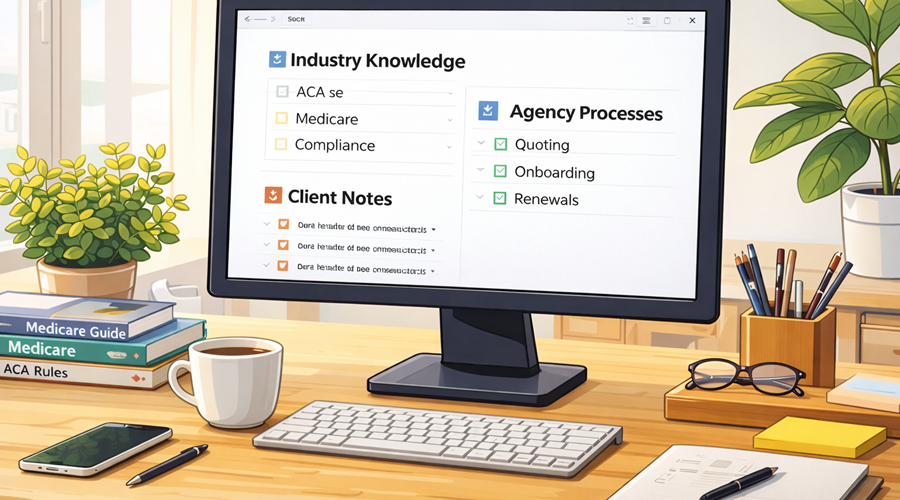
A tool like Workflowy works well for this because it’s built around an outline structure. Instead of burying information in folders, you organize it in a way that mirrors how you think about the business. You might have sections for industry knowledge like ACA, Medicare, and compliance, sections for your agency processes like quoting, onboarding, and renewals, and areas for client-specific notes when something unique comes up.
Your files can still live in folders, but your knowledge base becomes the place where everything is indexed and easy to find.
Think in Three Layers
When you start building a knowledge base, it helps to think about it in three layers.
At the top level is your industry knowledge: things like ACA rules, Medicare coordination, compliance requirements, funding strategies, and common plan designs. These are the concepts and answers that apply across multiple clients.
Next is your agency knowledge, which is how your business actually operates: your preferred carriers, key contacts, underwriting nuances, quoting processes, and renewal workflows. This is often the most underdeveloped area, even though it’s where you can save the most time.
Finally, there’s client-specific knowledge, including notes about a particular group, decisions that were made, unique plan setups, past issues, preferences, and history. This type of information is easy to lose but incredibly valuable when it’s organized and easy to revisit.
Most agents have pieces of all three, but rarely in one place.
You Build It Over Time
This isn’t something you sit down and build in a weekend. It’s something you build gradually, over time.
Every time you solve a problem, come across a good explanation, or answer a question that takes real thought, you add it. Most agents are already doing part of this. They download slides from CE classes, save helpful emails, and bookmark resources they want to remember.
This is simply taking that existing habit and giving it structure so it actually compounds.
A Shift in How We Share Content
That’s part of what we’re going to start doing differently with Benefits Weekly.
Instead of sending something to read and move on from, we’re going to share things you can actually keep: short videos, explainers, FAQs, compliance insights, and practical strategies. Content that’s worth saving and can become part of your own knowledge base.
So over time, you’re not just reading something each week; you’re building something you can come back to and use.
Build It Yourself, or Use a System
If you don’t want to build this yourself, that’s fine too.
We’re doing the same thing on our end at a much larger scale: organizing this type of information, structuring it, and making it searchable so you can ask a question and get an answer. But whether you build it yourself or use a system, the idea is the same: you need a place where your knowledge lives.
The agents who can quickly find and apply what they already know are the ones who operate more efficiently, serve their clients better, and ultimately grow faster.